AI Brief, 26 October 2026: sixty-eight copies of a model nobody has scored
Nanbeige LLM Lab, the model team inside the Chinese recruitment platform BOSS Zhipin, published Apache-2.0 weights for Nanbeige4.3-33B on 24 October, and finished the model card carrying its benchmark claims at 11:11 UTC on the 25th. The release went uncovered here on both days; it is late, and it matters for a reason that has little to do with the scores.
Ninety-one minutes after that card was finished, the first third-party conversion appeared. By early this morning there were 68 derivative repositories from 39 separate accounts, spanning GGUF, MLX, EXL3, NVFP4, FP8, MXFP8, GPTQ, AutoRound, W4A16 and W8A16, plus assorted abliterated builds. In the twenty-three hours between the weights landing and the benchmark table appearing, nobody converted anything at all. The cascade did not follow the artifact. It followed the claims.
What it has not produced is a number. Every figure anyone can quote about this model is still the lab's own, measured in the lab's own harness, and the reader of this brief has now seen the same shape three times in four days: on the 23rd a set of converted weights beat the originals to publication, on the 24th a lab's comparison table turned out to undersell its own model, and today a 66 GB checkpoint has been re-encoded into ten numeric formats by people who cannot yet say whether any of those encodings preserve what the model does. Conversion has become roughly a thousand times faster than evaluation, and the gap is now the story rather than a footnote to it.
The loudness is worth stating precisely, because it points three different ways at once. On Hugging Face the model has 412 likes. On Hacker News, where it was submitted at 13:01 UTC on the 25th, it has two points. Between those sits the only community effort anyone actually spent: sixty-eight repositories of arithmetic.
- Nanbeige4.3-33B: dense 33.1B, Apache-2.0, bilingual, from BOSS Zhipin's in-house lab; explicitly built as a teacher model to distil into a 3B successor.
- Self-reported 23.8 on Terminal-Bench 4.0 against 6.3 for Qwen3.8-27B and 0.0 for Gemma4-31B, all four models run by the lab in one harness.
- 68 third-party conversions from 39 accounts in 15 hours 54 minutes, and no independent score.
- The instruct config advertises a 512k context; the base model it is built on advertises 128k, and the card does not mention extending it.
- The shipped instruct config sets
use_cache: false, which silently removes the KV cache from anything that loads it without overriding the flag. - JetBrains ThinkRail, an Apache-2.0 agentic IDE wrapped around a third-party MIT agent, took 195 points on Hacker News on the 25th at 1,967 stars.
A teacher model from a recruitment company
Nanbeige is not a new name, but it is not a tracked one either. The lab sits inside Kanzhun Limited,
which operates BOSS Zhipin; the contact address on the card is nanbeige@kanzhun.com. Its previous
release, Nanbeige4.2-3B in July, got native SGLang support in September.
The strategy stated on the card is its most interesting claim. Nanbeige4.3-33B is positioned not as a product but as a teacher: "a high-capacity teacher agent first, which will subsequently anchor the distillation of advanced agentic capabilities into smaller models", with Nanbeige4.3-3B named as the target. A 33B model released publicly, under a permissive licence, whose stated job is to train a model a tenth its size.
The table compares it against Qwen3.8-27B, Muse-Glimmer-30B and Gemma4-31B, all at highest thinking effort. The lab says it ran every model itself, in the same harness, with the same hyperparameters, which is the opposite of the methodology problem this brief covered on the 24th, when Moonshot's table compared its own harness runs against rivals' best-ever published figures and thereby understated its own model. Running everything yourself removes that asymmetry and introduces a different one: nobody outside can check any of it.
The collapse between the two rows is the part worth keeping. On Terminal-Bench 2.1 every model scores between 47 and 81, a spread a reader could mistake for a crowded field. On 4.0 three of the four flatline and Gemma4-31B returns a literal zero. Whatever 4.0 measures, three 30B-class models cannot currently do it at all, and the one scoring 23.8 is far below the 65.7 Moonshot self-reported for its 3T-class K3.1 Pro on the same benchmark two days ago.
The card's weakest moment is prose, not arithmetic. It says the model "outperforms the baseline in most of the 35 occupations evaluated" on JobBench. Its own figure is more specific and less flattering: Nanbeige leads Qwen3.8-27B on 26 of the 35, trails on eight, ties on one.
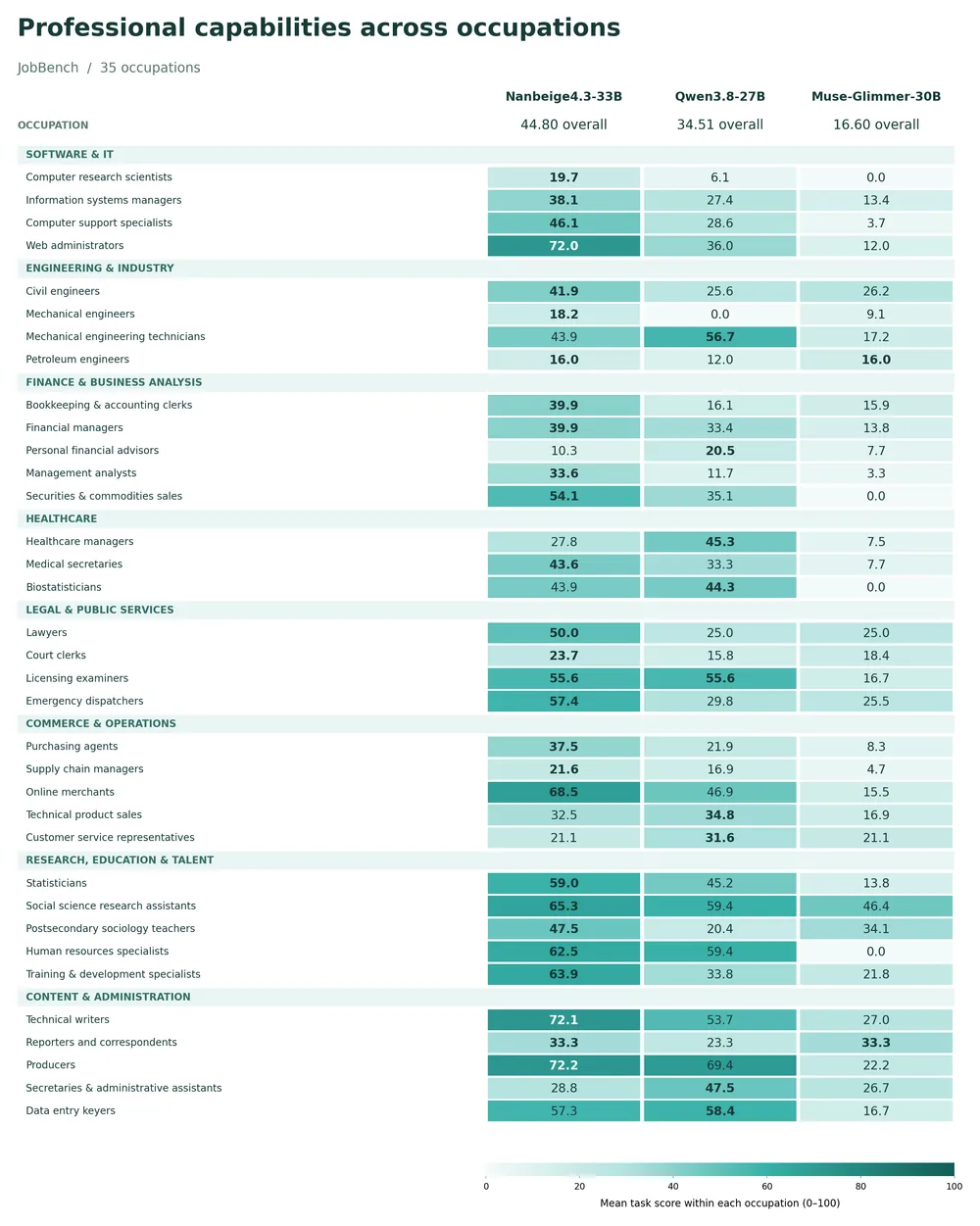
The eight it loses cluster in clerical, people-facing work: healthcare managers, customer service representatives, secretaries, data entry keyers. A recruitment company's model is strongest on technical writing and web administration and weakest on the desk jobs its parent platform mostly advertises. That is one self-run harness and should not be read as more than it is.
The 512k context its own config does not agree on
The card states the model "supports a context length of up to 524,288 tokens (512K)", and
config.json on the instruct repository agrees. The base model it is built from,
Nanbeige4.3-33B-Base, declares 131072.
A four-fold context extension during post-training is ordinary engineering, but the card does not
mention it, publishes no long-context evaluation beyond a single AA-LCR score of 84.0, and gives no
recipe. The 512k figure is an unevidenced config value.
It is also, on its own numbers, close to unusable. The model is dense, with 52 layers, 8 key-value heads and a head dimension of 128, so the KV cache per token in bf16 is
where the 52 counts layers, the first 2 counts keys and values separately, 8 is num_key_value_heads,
128 is head_dim, and the final 2 is bytes per bf16 element. That is 208 KiB per token. Filling the
advertised window costs
against 66.24 GB of weights across the repository's 14 safetensors shards. At its own maximum
context the cache is 1.7 times the model, so one full-length request needs roughly 178 GB before
activations: three 80 GB accelerators for a single conversation. The card's recommended
--tensor-parallel-size 4 looks like a floor rather than a suggestion.
One more thing in that file will cost someone an afternoon. The instruct config ships with
use_cache set to false, where the base model has it true:
from transformers import AutoModelForCausalLM

m = AutoModelForCausalLM.from_pretrained(
    "Nanbeige/Nanbeige4.3-33B", torch_dtype="auto", device_map="auto",
    trust_remote_code=True,
)
print(m.config.use_cache)          # False, straight from the shipped config.json
m.config.use_cache = True          # the line the quickstart does not include
Left alone, generate re-reads the whole prefix at every step instead of reusing cached keys and
values. Nothing errors and nothing warns; the model simply produces correct tokens far more slowly
than it should, which is the worst shape a default can have, and the card's own Transformers snippet
does not touch it. Serving through vLLM or SGLang sidesteps it, as both manage their own cache.
Sixty-eight conversions, and not one score
The first derivative, a Q4_K_S GGUF, appeared at 12:42:47 UTC on 25 October; the most recent at the time of writing, an MXFP8 build, at 04:36:59 on the 26th. In the 15 hours and 54 minutes between, 39 accounts published 68 repositories: 16 GGUF variants, 16 MLX builds from 3 to 8 bits, five EXL3 quantisations down to 2.5 bits per weight, five AutoRound, four NVFP4, four W4A16, three FP8, two W8A16, one GPTQ, one MXFP8, a ROCm FPX build, and a scattering of "abliterated" and "Heretic" variants with the refusal behaviour removed.
None of this is coordinated and none of it is wrong. It is genuinely useful: within a day of a 66 GB bf16 checkpoint existing, someone on a Mac, someone on ROCm and someone with a 24 GB consumer card can all load it. The 23 October brief covered the inverse case, where MiniMax's converted weights reached the public almost a day before the originals; this is the same machinery.
The asymmetry is cheap to fix and nobody is fixing it. Re-quantising takes a script and an hour of GPU time; running Terminal-Bench 4.0 against the result takes a harness, a budget and a day, and confers no repository of one's own. The incentives point entirely at the first.
JetBrains ships an IDE built around someone else's agent
ThinkRail reached the Hacker News front page at
16:27 UTC on 25 October with 195 points and 145 comments, a day after a 56-point submission of
its website. It is a JetBrains incubator project, Apache-2.0, TypeScript, at 1,967 stars and 208
open issues, with a nightly build, v0.3.0-nightly.6, published inside this window at 06:49 UTC.
The last stable tag is v0.2.0 on 18 October.
The notable thing is architectural. JetBrains sells IDEs and has its own AI assistant line, yet
ThinkRail is an interface wrapped around pi, a coding agent it did not write:
@earendil-works/pi-coding-agent,
MIT-licensed, 61 versions since May, most recently 1.4.0 on 21 October. An IDE vendor treating the
agent as a replaceable component rather than the product is a different bet from the one most of its
competitors have made. The design idea underneath is isolation by git worktree: each agent session
gets its own branch and working directory, so several run in parallel without touching your checkout,
with a graph of SPEC.md files the agent maintains as durable project knowledge.
The thread argued that local isolation is the wrong unit altogether, making the case for agents on remote VMs with their own browsers and secrets rather than on a developer's laptop. At 208 open issues against 1,967 stars and no stable release in a week, ThinkRail is an early project with an unusually large sponsor, not a finished tool.
Also notable
- A dermatologist measured two frontier models against a 2015 CNN, and published the protocol. Magnus Lynch gave 200 biopsy-proven skin lesions from the public MILK10k dataset — 100 that should not be discharged, 100 that are safe to — to GPT-6 Astra, Claude Fable 5.1 and a fine-tuned Inception v3, each lesion as both a clinical photograph and a dermoscopic image. The CNN named the correct diagnosis out of six for 125 of 200 (62%); the two frontier models managed 84 and 85 (42%). On the case he leads with, an invasive melanoma on an ear, both models called it a harmless seborrhoeic keratosis and said the patient could be discharged. One clinician's single run wants replication, but it is more measurement than the day's biggest model release has attracted.
- Max Woolf asked why inference prices fell up to 80% in months, working through distillation, batching and serving efficiency rather than taking the announcements at face value, published 21:00 UTC on the 25th.
r/opensourcebanned submissions of projects built with, by, or for AI, per The Verge.- Kimi K3.1 Pro's launch drew scrutiny over allegedly undisclosed paid promotion, per reporting clustered on Techmeme on the 25th. Covered here on the 24th; the promotion claim has no underlying artifact and is noted unconfirmed.
- llama.cpp's 25 October build tags include one hardening fix worth knowing: the GBNF grammar parser now enforces a recursion-depth limit, so an unbounded recursive grammar fails cleanly instead of exhausting the stack.
- No new model weights came from the majors. A sweep of sixteen organisations on Hugging Face,
including Qwen, DeepSeek, Google, Meta, Mistral, Microsoft, NVIDIA, OpenAI and Moonshot, found no
model repository created after 04:30 UTC on 25 October. Anthropic's
oss-scanner, which reached wider notice on the 25th, was created on 8 October and is not a release from this window. - Reddit's
r/LocalLLaMAandr/MachineLearningremain unreachable, so the usual first reactions to a 33B open-weights drop are not reflected above.
What to watch
- The first independent number on Nanbeige4.3-33B. The weights are Apache-2.0 and the harnesses are named in the card's own footnotes, including mini-swe-agent v2.4.6 for Terminal-Bench 4.0, so 23.8 is directly checkable by anyone with the model and a budget. The more useful figure is a quantised one: any of the 68 derivatives scored against the bf16 original would be the first evidence that this cascade preserves anything.
- Whether SGLang and vLLM merge native Nanbeige4.3 support. Both did for Nanbeige4.2 in September, SGLang first, and until a serving engine carries the architecture natively the practical audience for a 33B model is smaller than its download count suggests.
- Whether the 512k claim gets a recipe or an evaluation. The base model declares 128k. One long-context benchmark run, or one sentence in the card about how the window was extended, settles whether 524288 is a capability or a config value.
- Still open: no decision-model vendor has published a fail-open rate, asked here daily since 10 October and now seventeen days. Kimi K3.1 Pro's weights remain absent against a promised 4 November date, with no second independent harness on its Terminal-Bench 4.0 figure; MiniMax has published no unquantised M3.1 Flash reference, flagged since the 23rd; and Voxtral 3 weights are still absent, flagged every day since the 21st.